In kidney cancers, the surgical treatment plan is not a one-dimensional process focused only on removing the tumor. The patient’s age, general health condition, kidney functions, the tumor’s location in the kidney, its size, its relationship with vascular structures, and the functional capacity of the other kidney are evaluated together. For this reason, robotic surgery in kidney cancers stands out as an important surgical option in suitable patients, aiming both to safely remove cancerous tissue and to preserve healthy kidney tissue. The robotic system transfers the surgeon’s hand movements to sensitive instruments and allows the surgical field to be viewed in greater detail with three-dimensional magnified imaging support. This feature may make surgical planning more controlled, especially in tumors limited to a specific part of the kidney. However, robotic surgery is not automatically suitable for every patient; the decision should be made through a personalized medical evaluation.
- What Is Kidney Cancer?
- What Is Robotic Surgery in Kidney Cancers?
- In Which Cases Is Robotic Kidney Cancer Surgery Performed?
- What Is Robotic Partial Nephrectomy?
- Why Is Kidney-Sparing Surgery Important?
- When May Robotic Radical Nephrectomy Be Required?
- What Are the Advantages of Robotic Surgery in Kidney Cancers?
- How Is Preoperative Evaluation Performed?
- How Is Robotic Kidney Cancer Surgery Performed?
- The Role of Robotic Surgery in Urology for Kidney Cancer
- What Is the Recovery Process Like After Surgery?
- Is Robotic Surgery Suitable for Every Patient With Kidney Cancer?
- Follow-Up After Robotic Surgery in Kidney Cancers
- Frequently Asked Questions About Robotic Surgery in Kidney Cancers

What Is Kidney Cancer?
kidney cancer is a malignant disease that develops when cells in the kidney tissue multiply uncontrollably. It may not always cause clear symptoms in the early stages and may therefore be detected incidentally during ultrasound, computed tomography, or MRI performed for another reason. In symptomatic patients, findings such as blood in the urine, flank pain, a palpable abdominal mass, fatigue, loss of appetite, weight loss, or unexplained fever may be observed. However, these symptoms are not specific only to kidney cancer; kidney stones, infections, or different urological diseases may also cause similar complaints. Therefore, when a kidney mass is detected, detailed imaging, blood tests, and urological evaluation are required. When creating a treatment plan, the suspicion of cancer, the part of the kidney where the tumor is located, its relationship with surrounding tissues, and the patient’s kidney functions are evaluated together.

What Is Robotic Surgery in Kidney Cancers?
Robotic surgery is one of the minimally invasive surgical methods performed through robotic arms controlled by the surgeon from a console. In this method, the robot does not perform the surgery on its own; the surgeon manages the operation, and the surgeon’s console movements are precisely transferred to the robotic surgical instruments. Three-dimensional magnified imaging, high mobility, and the ability to work in narrow areas in a controlled manner may support surgical planning in kidney tumors. Especially in patients whose tumor is limited to a specific part of the kidney, the robotic method may aim to remove only the tumor-bearing area. This approach is important for preserving healthy kidney tissue. Robotic surgery may be performed with smaller incisions compared to open surgery; however, the suitability of the method varies according to the tumor’s location, size, relationship with vessels, and the patient’s general health condition. Therefore, the same surgical approach is not applied to every kidney cancer patient.
In Which Cases Is Robotic Kidney Cancer Surgery Performed?
Robotic kidney cancer surgery may be considered in patients whose tumor can be safely removed using the robotic method. This decision is not made solely according to the tumor size in centimeters. Whether the tumor is close to the outer surface of the kidney, how deeply it extends into the kidney, its relationship with main vessels and the urinary collecting system, the condition of the other kidney, and the patient’s additional diseases are evaluated together. While robotic partial nephrectomy may be preferred in small tumors limited to a specific area of the kidney, radical nephrectomy may be required in large tumors or tumors affecting a significant part of the kidney. Robotic surgery may contribute to more precise dissection, controlled separation of the tumor from surrounding tissues, and a more planned kidney tissue preservation approach in selected patients. However, the robotic method may not be suitable for every patient; open or laparoscopic surgical options may also be included in the evaluation process.
Robotic surgery may be considered in the following situations:
If the tumor is located in a limited part of the kidney
If preservation of healthy kidney tissue is targeted
If the tumor has a surgically manageable relationship with vascular structures
If the patient’s general health condition is suitable for minimally invasive surgery
If the function of the other kidney needs to be preserved
If previous surgeries do not prevent a robotic approach
What Is Robotic Partial Nephrectomy?
Robotic partial nephrectomy is a surgical procedure in which only the tumor-bearing area of the kidney is removed while healthy kidney tissue is preserved as much as possible. The aim of this surgery is to remove cancerous tissue with safe surgical margins and allow the remaining kidney to continue functioning. Partial nephrectomy is an important option, especially in small and limited kidney tumors. Removing only the tumor-bearing section instead of the entire kidney may contribute to the preservation of kidney functions in the long term. This becomes even more important in patients with a single kidney, tumors in both kidneys, limited kidney function, or a risk for kidney health in the following years. The robotic system may technically facilitate clearer visualization of tumor borders, precise cutting, and repair of kidney tissue. However, the suitability of partial nephrectomy should be evaluated separately for each patient.
Why Is Kidney-Sparing Surgery Important?
Kidney-sparing surgery is an approach that aims to preserve healthy kidney tissue as much as possible while removing cancerous tissue. The kidneys play important roles in maintaining fluid balance in the body, filtering waste products, regulating blood pressure, and supporting certain metabolic processes. Therefore, the goal in kidney cancer surgeries is not only to remove the tumor but also to protect the patient’s long-term kidney health. In suitable patients, the tumor-bearing area may be removed with partial nephrectomy without removing the entire kidney. This approach may help reduce the risk of kidney failure in the future; however, it does not guarantee the same result for every patient. A centrally located tumor, a tumor that has reached a large size, or a close relationship with vascular structures may make kidney-sparing surgery more difficult. Therefore, surgical planning is performed by considering imaging findings, kidney function tests, and the patient’s general condition.
| Surgical Approach | Main Purpose | When May It Be Considered? |
|---|---|---|
| Partial nephrectomy | To remove the tumor-bearing area and preserve healthy kidney tissue | It may be preferred in small, limited, and suitably located tumors. |
| Radical nephrectomy | To remove the entire kidney | It may be required in large, extensive tumors or tumors unsuitable for kidney-sparing surgery. |
| Robotic approach | To provide precise surgery with a minimally invasive method | It may be evaluated for partial or radical nephrectomy under suitable anatomical and medical conditions. |
| Open surgery | To provide a wider surgical field | It may be considered in large, complex tumors or tumors unsuitable for a robotic approach. |
When May Robotic Radical Nephrectomy Be Required?
Radical nephrectomy means the surgical removal of the entire kidney. This method may be required when the tumor is large, involves a significant part of the kidney, is centrally located, has a close relationship with vascular structures, or when partial nephrectomy is not safe. Robotic radical nephrectomy is one of the minimally invasive surgical options that can be performed with small incisions in suitable patients. During the surgery, the kidney’s vascular connections are carefully separated, and the kidney is removed. In some patients, surrounding tissues or lymph nodes may also be included in the surgical evaluation. The function of the other kidney is especially important when deciding on radical nephrectomy. If the other kidney is functioning well, the patient can continue life with one kidney. However, if conditions such as hypertension, diabetes, advanced age, or existing kidney function impairment are present, postoperative follow-up should be planned more carefully. Therefore, the radical nephrectomy plan is determined not only according to tumor size but also by evaluating kidney functions, additional diseases, and the patient’s general health condition together.
What Are the Advantages of Robotic Surgery in Kidney Cancers?
Advantages of robotic surgery include performing surgery through small incisions, three-dimensional magnified imaging, high mobility of surgical instruments, precise tissue dissection, and more careful bleeding control. Since the kidney is an organ with dense vascular structures, vascular control and tissue separation during surgery are very important. The robotic system may help the surgeon work more controllably in narrow areas. During partial nephrectomy, the kidney tissue must be repaired after the tumor is removed; the precise suturing capability of the robotic system may provide technical ease at this stage. However, robotic surgery is not a risk-free procedure. Risks such as bleeding, infection, urine leakage, changes in kidney function, anesthesia-related problems, or the need for additional surgery may occur. Therefore, it is important to provide balanced information when explaining the advantages to the patient. The robotic method should be considered as an option that supports the surgical process in suitable patients and suitable tumor characteristics.
The prominent aspects of the robotic method include:
Surgery can be performed through small incisions
The surgical field can be viewed in three dimensions and magnified
It provides precise mobility in narrow areas
It helps separate tissues around the tumor in a more controlled manner
It technically supports kidney repair during partial nephrectomy
It allows the patient’s recovery process to be followed in a more planned way
How Is Preoperative Evaluation Performed?
Before kidney cancer surgery, evaluation should be performed in detail. With computed tomography or MRI, the tumor’s size, location in the kidney, depth, relationship with vessels, proximity to the urinary collecting system, and suspicion of spread to surrounding tissues are examined. These imaging results provide important information about whether partial nephrectomy or radical nephrectomy will be performed. Blood tests are used to evaluate kidney functions, blood values, coagulation status, and general health indicators. If the patient has hypertension, diabetes, heart disease, lung disease, or a history of major abdominal surgery, this information is taken into account during surgical planning. Anesthesia evaluation is also necessary for surgical safety. The aim of the preoperative process is to determine the appropriate method for the patient, reduce risks, and create the postoperative follow-up plan in advance. This preparation stage is important for the safe application of robotic surgery with proper patient selection.
How Is Robotic Kidney Cancer Surgery Performed?
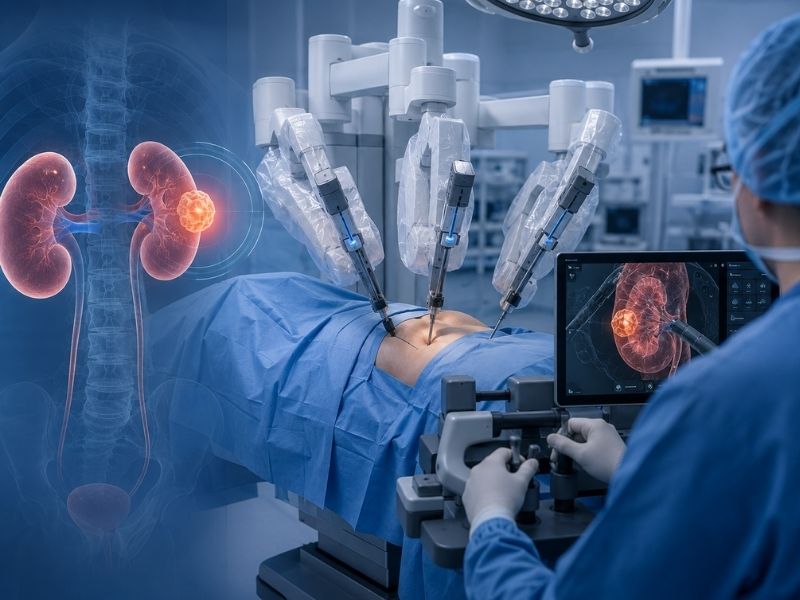
Kidney tumor surgery is performed under general anesthesia. In the robotic method, several small incisions are made in the abdominal area, and a camera and robotic surgical instruments are inserted through these incisions. The surgeon controls the operation from the robotic console and evaluates the kidney, tumor, and surrounding tissues with three-dimensional imaging. In patients planned for partial nephrectomy, the tumor-bearing area is carefully removed, and the remaining kidney tissue is repaired. At this stage, bleeding control, preservation of tumor margins, and closure of kidney tissue are important. In patients requiring radical nephrectomy, the entire kidney is removed. The duration of surgery varies according to the tumor’s size, location in the kidney, the patient’s anatomy, previous surgeries, and the scope of the operation. Not every surgery proceeds in the same way. In some cases, the surgical plan may change during the procedure, and a different method may be used for the patient’s safety.
The Role of Robotic Surgery in Urology for Kidney Cancer
Robotic surgery in urology is one of the minimally invasive surgical approaches used in prostate, kidney, bladder, and certain urinary tract surgeries. In kidney cancers, the robotic method has become an important option, especially in tissue-sparing surgeries such as partial nephrectomy. This is because the kidney is both a highly vascular organ and preservation of healthy kidney tissue is valuable for long-term health. Robotic surgery may support the surgeon by providing magnified imaging and precise movement, helping separate the tumor from surrounding tissues and repair the kidney. However, robotic surgery is not the only standard method to be applied in every patient. While open surgery may be safer in some patients, a laparoscopic approach may be preferred in others. Therefore, the correct method should be determined according to the tumor stage, location, the patient’s kidney function, and the surgeon’s evaluation.
What Is the Recovery Process Like After Surgery?
Recovery after robotic kidney cancer surgery may vary depending on whether the procedure was partial or radical, the patient’s age, general health condition, and the course of the surgery. In the first days, pain control, fluid intake, urine monitoring, early walking, and regulation of nutrition are important. In surgeries performed with small incisions, wound care may be more limited; however, this does not mean that postoperative controls can be neglected. The length of hospital stay varies from person to person. After discharge, the patient should avoid heavy lifting, avoid sudden movements, take medications prescribed by the doctor regularly, and attend follow-up appointments. Situations such as heavy blood in the urine, high fever, progressively increasing pain, shortness of breath, marked redness at the wound site, or discharge should be taken seriously. During the postoperative period, the patient should follow the doctor’s recommended program regarding return to daily life.
Is Robotic Surgery Suitable for Every Patient With Kidney Cancer?
Although robotic surgery is an important option in kidney cancers, it may not be suitable for every patient. Very large tumors, tumors deeply located in the center of the kidney, close relationship with major vessels, suspicion of spread to surrounding tissues, or previous abdominal surgeries may affect the choice of method. In addition, if there are advanced heart, lung, or anesthesia-related risk factors, the surgical approach is reevaluated accordingly. While robotic partial nephrectomy may be suitable in some patients, robotic radical nephrectomy may be required in others. In more complex cases, open surgery may be a safer option. Therefore, the suitability of robotic surgery should be determined not only based on technological availability but by considering all medical characteristics of the patient. The aim of the treatment plan is to provide cancer control, preserve kidney functions whenever possible, and prioritize the patient’s overall safety.
Follow-Up After Robotic Surgery in Kidney Cancers
The follow-up process after robotic kidney cancer surgery is an inseparable part of treatment. The pathology result of the removed tissue provides information about the tumor type, grade, surgical margin status, and stage. According to these results, the patient’s control intervals, imaging plan, and whether additional treatment is needed are determined. Blood tests, kidney functions, urine evaluations, and imaging methods may be used during follow-up. In patients who undergo partial nephrectomy, the function of the remaining kidney tissue is monitored. In patients who undergo radical nephrectomy, the function of the other kidney is checked regularly. Follow-up after kidney cancer treatment is important both for monitoring the risk of possible recurrence and for preserving kidney functions in the long term. The patient’s blood pressure control, fluid intake, medications used, and additional diseases should also be taken into account during this process.
Frequently Asked Questions About Robotic Surgery in Kidney Cancers
Can kidney cancer surgery be performed with a minimally invasive method?
Yes, in suitable patients, kidney cancer surgery can be performed with laparoscopic or robotic methods as a minimally invasive procedure. The choice of method is determined according to the size and location of the tumor and the patient’s general health condition.
Does the kidney continue to function if part of it is removed?
In suitable patients, when only the tumor-bearing part of the kidney is removed, the remaining healthy tissue may continue to function. Therefore, partial nephrectomy is an important option for preserving kidney functions.
How many hours does robotic kidney surgery take?
The duration of robotic kidney surgery varies depending on the location of the tumor, whether the surgery is partial or radical, and the patient’s anatomical characteristics. The exact duration can be planned more clearly after the preoperative evaluation.
Can a kidney tumor recur after it is removed?
The risk of recurrence after removal of a kidney tumor varies depending on the tumor type, stage, grade, and surgical margin status. Therefore, regular follow-up after surgery is important.
Does robotic kidney surgery leave a scar?
Since robotic kidney surgery is performed through small incisions, it usually does not create a large surgical scar. However, small scars that become less noticeable over time may remain at the incision sites.
What should be considered after kidney cancer surgery?
After surgery, it is important to avoid heavy lifting, drink enough fluids, attend follow-up appointments, and follow the doctor’s recommendations. In cases such as fever, severe pain, or heavy blood in the urine, medical attention should be sought without delay.
Is it possible to live with one kidney?
Yes, it is possible to live with one kidney if the remaining kidney functions well. In this case, blood pressure, kidney functions, and general health should be monitored at regular intervals.