





- What Is Robotic Surgery For Benign Prostatic Enlargement?
- Is Robotic Surgery Necessary For Every Patient With Prostatic Enlargement?
- What Is Robotic Simple Prostatectomy?
- When Is Robotic Surgery Considered In Benign Prostatic Enlargement?
- The Role Of Robotic Surgery In Large Prostates
- How Is Robotic Prostate Surgery Performed?
- Differences Between Robotic Surgery, HoLEP And TUR-P
- How Is Evaluation Performed Before Robotic Surgery?
- Recovery Process After Robotic Prostate Surgery
- What Should Be Considered After Robotic Surgery?
- Is Robotic Surgery Suitable For Every Patient With Prostatic Enlargement?
- Frequently Asked Questions About Robotic Surgery For Benign Prostatic Enlargement
- Can robotic prostate surgery be performed for benign prostatic enlargement?
- How many hours does robotic prostate surgery take?
- How many days does the catheter stay after robotic prostate surgery?
- In large prostates, is robotic surgery or HoLEP preferred?
- Can urinary incontinence occur after robotic prostate surgery?
- Does robotic prostate surgery affect sexuality?
- Who is not suitable for robotic surgery in benign prostatic enlargement?

Robotic surgery for benign prostatic enlargement is one of the surgical options evaluated in selected patients to reduce the pressure caused by prostate tissue on the urinary canal. Robotic surgery is not required for every patient with benign prostatic enlargement, because the treatment plan is determined according to the patient’s complaints, prostate volume, urine flow, bladder emptying status, and kidney functions. While follow-up or medication may be sufficient in mild symptoms, robotic surgery may come to the agenda in patients with advanced obstruction, markedly enlarged prostate volume, or in cases requiring special evaluation for different treatment methods. Unlike prostate cancer surgery, the aim of this method is to remove the benign enlarged part of the prostate that narrows the urinary tract and to improve urine flow.
What Is Robotic Surgery For Benign Prostatic Enlargement?
Benign prostatic enlargement is a condition in which the prostate gland grows with age and compresses the urinary canal, making urination difficult. Robotic surgery is one of the minimally invasive surgical methods performed with robotic arms and special surgical instruments controlled by the surgeon through a console. In this method, the robot does not perform the surgery on its own; the surgeon’s movements at the console are precisely transferred to the robotic surgical instruments.
The aim of robotic surgery in benign prostatic enlargement is to remove the enlarged inner prostate tissue that blocks urine flow and to help the bladder empty more comfortably. This approach may be considered especially in very large prostates, in some patients for whom open surgery may be considered, or in cases where more controlled management of the surgical field is desired. However, suitability should be decided separately for each patient.

Is Robotic Surgery Necessary For Every Patient With Prostatic Enlargement?
Robotic surgery is not a necessary method for every patient with prostatic enlargement. In patients with mild urinary complaints, sufficient bladder emptying, and unaffected kidney functions, follow-up or medication may be enough. TUR-P or HoLEP may also be considered in patients with suitable prostate volume.
Robotic surgery is mostly considered in selected patient groups, especially when prostate volume is significantly large and the obstruction in the urinary canal has reached an advanced level. Therefore, the use of the robotic method is not only related to technological availability but also to the patient’s medical characteristics. When preparing the treatment plan, prostate size, the amount of urine remaining in the bladder, urine flow rate, previous catheter requirement, and the patient’s general health status should be evaluated together.
What Is Robotic Simple Prostatectomy?
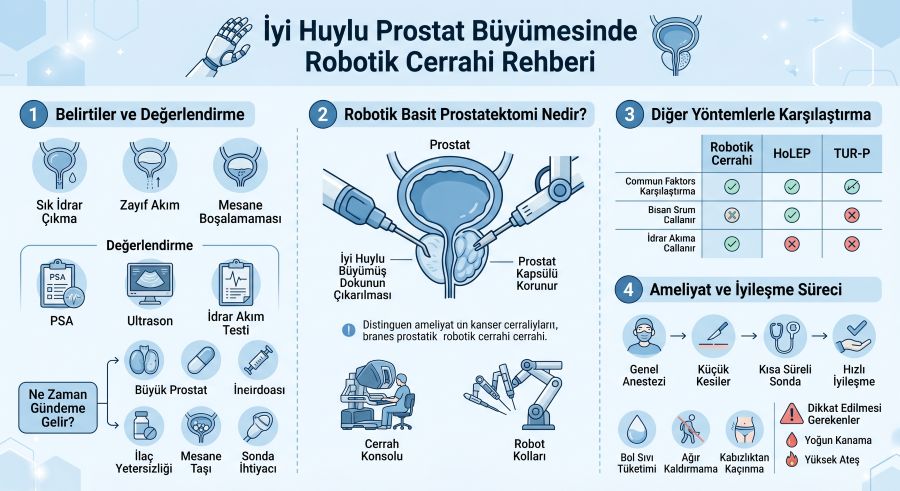
Robotic simple prostatectomy is the removal of the inner part of the benign enlarged prostate tissue that narrows the urinary tract with the help of robotic surgery. This operation is different from radical prostatectomy performed for prostate cancer. In radical prostatectomy, the entire prostate is removed for cancer treatment, whereas in robotic simple prostatectomy, the aim is to relieve obstruction caused by benign enlargement.
The outer capsule of the prostate is preserved, and the enlarged tissue compressing the urinary canal is removed. This method may be considered especially in patients with a large prostate volume, insufficient benefit from medication, or significant urinary obstruction. When deciding on surgery, prostate enlargement alone is not considered sufficient; the patient’s urinary complaints, bladder function, and suitability for other surgical options should be evaluated together.
When Is Robotic Surgery Considered In Benign Prostatic Enlargement?
Robotic surgery is generally considered in benign prostatic enlargement in cases of advanced urinary obstruction, large prostate volume, or insufficient response to medication. If the patient urinates frequently, cannot empty the bladder completely, wakes up at night due to urination, or has a markedly weak urine stream, a detailed evaluation is required.
In some patients, recurrent inability to urinate, catheter requirement, bladder stones, recurrent bleeding in the urine, or kidney involvement may also bring the surgical option forward. At this point, robotic surgery may be considered as an alternative surgical approach, especially in large prostates where open surgery could be considered. However, robotic surgery is not mandatory for every large prostate. The appropriate method is determined according to prostate volume, degree of obstruction, the patient’s general condition, and the surgeon’s evaluation.
Robotic surgery may be considered in the following situations:
Markedly enlarged prostate volume
Persistent urinary complaints despite medication
Incomplete bladder emptying
Recurrent inability to urinate and catheter requirement
Presence of bladder stones or recurrent bleeding
Beginning impairment of kidney functions
Patient groups in whom a minimally invasive approach may be considered instead of open surgery
The Role Of Robotic Surgery In Large Prostates
When planning prostate treatment for large prostates, prostate volume, the degree of obstruction in the urinary tract, and bladder function are evaluated together. In large prostates, laser methods such as HoLEP may be suitable for some patients, while robotic simple prostatectomy may be considered in others.
Robotic surgery is a method that can be performed through small incisions in the abdominal area and provides the surgeon with controlled work under magnified imaging. Especially in very large prostates, surgical planning is important for removing the enlarged tissue and carefully controlling bleeding. However, choosing the robotic method does not mean that other methods are insufficient. The main goal of treatment is to improve the patient’s urine flow, support bladder emptying, and reduce problems that may be caused by long-term obstruction. Therefore, method selection should be personalized.
How Is Robotic Prostate Surgery Performed?
Robotic prostate surgery is usually performed under general anesthesia. Small incisions are made in the abdominal area, and a camera and robotic surgical instruments are placed through these incisions. The surgeon controls the robotic system from the console and removes the enlarged inner prostate tissue narrowing the urinary tract under three-dimensional magnified imaging.
The aim of this procedure is not to treat prostate cancer, but to relieve urinary obstruction caused by benign enlargement. During surgery, the bladder neck, prostate tissue, and urinary tract are carefully evaluated. The removed tissue may be sent for pathological examination. The duration of surgery varies depending on the size of the prostate, the patient’s anatomical characteristics, and the scope of the surgery. After the procedure, catheter use may be required for a certain period to ensure healthy urine flow.
Differences Between Robotic Surgery, HoLEP And TUR-P
HoLEP surgery, TUR-P surgery, and robotic surgery are methods evaluated in different patient groups to relieve urinary obstruction caused by benign prostatic enlargement. In HoLEP, prostate tissue is separated from the capsule level using laser energy. In TUR-P, the obstructing part of the prostate is removed piece by piece through the urinary canal. In robotic surgery, especially in large prostate volumes, the inner enlarged prostate tissue may be removed through small incisions in the abdominal area.
There is no single standard choice among these methods that applies to all patients. The selection is made according to prostate volume, the degree of narrowing in the urinary canal, bladder condition, bleeding risk, medications used, and surgical evaluation. The patient’s expectations are also discussed; however, the final decision should be based on medical suitability.
| Method | Application Principle | In Which Patients Can It Be Considered? |
|---|---|---|
| Robotic surgery | Removal of large prostate tissue with a minimally invasive method | Selected patients with large prostates |
| HoLEP | Separation of prostate tissue with laser | Suitable patients with different prostate volumes |
| TUR-P | Removal of prostate tissue through the urinary canal | Patients with suitable prostate size |
| Open surgery | Removal of tissue through a wider incision | Some large and complex prostate cases |
How Is Evaluation Performed Before Robotic Surgery?
Before robotic surgery, not only the size of the prostate but also the level of its effect on the urinary system is evaluated. PSA test, urinalysis, blood tests, kidney functions, ultrasound, prostate volume measurement, urine flow test, and the amount of urine remaining in the bladder after urination are important in this process. In patients deemed necessary, the urinary canal and inside of the bladder may be examined with cystoscopy.
The patient’s blood thinners, diabetes medications, blood pressure medications, and additional diseases are reviewed in detail before surgery. An anesthesia evaluation is also necessary to plan the surgery safely. The aim of this preparation process is to determine whether robotic surgery is truly suitable and to make the postoperative process more predictable. Depending on the evaluation result, different surgical methods may also be considered.
The following points are generally evaluated before surgery:
Prostate volume and its effect on the urinary tract
PSA and blood test results
Urine flow rate
Amount of urine remaining in the bladder
Kidney functions
Use of blood thinners and regular medications
Additional diseases and anesthesia suitability
Recovery Process After Robotic Prostate Surgery
The recovery process after prostate surgery may vary depending on the patient’s age, prostate size, scope of surgery, and general health condition. A catheter may be used for a certain period after robotic surgery. In the first days, mild bleeding in the urine, burning, frequent urination, sudden urgency, or changes in urine color may occur. These symptoms usually decrease over time in most patients; however, heavy bleeding, passing clots, fever, inability to urinate, or severe pain should be evaluated without delay.
After discharge, drinking plenty of fluids, avoiding heavy lifting, preventing constipation, and staying away from intense exercise for the period recommended by the doctor are important. During follow-up appointments, urine flow, wound healing, pathology results, and general recovery are evaluated. Since every patient’s recovery time is not the same, follow-up should be planned individually.
What Should Be Considered After Robotic Surgery?
In the early period after robotic surgery, the patient’s urine color, catheter status, pain level, fever, and general health condition should be carefully monitored. Mild burning, frequent urination, or short-term bleeding in the urine may be expected; however, worsening complaints should not be considered normal. Especially in cases of intense red bleeding, large clots, inability to urinate, high fever, foul-smelling discharge, severe abdominal pain, or significant deterioration in general condition, a healthcare center should be contacted.
Return to daily life should be planned according to the doctor’s recommended program. In the early period, the patient should not lift heavy objects, should avoid constipation that may cause prolonged straining, and should pay attention to the recommended fluid intake. Not missing follow-up appointments after surgery is important for proper monitoring of recovery.

Is Robotic Surgery Suitable For Every Patient With Prostatic Enlargement?
Robotic surgery may not be suitable for every patient with benign prostatic enlargement. Suitability is determined according to many factors such as prostate volume, bladder condition, deterioration in urine flow, kidney functions, age, additional diseases, use of blood thinners, and anesthesia risk. In some patients, medication or follow-up may be sufficient. While HoLEP or TUR-P may be more appropriate in some patients, robotic simple prostatectomy may be considered in selected patients.
Therefore, when deciding between surgical options, it is not correct to look only at the question “which method is newer?” What matters most is choosing the method appropriate for the patient’s degree of obstruction and medical condition. Robotic surgery may be planned as one of the surgical options aimed at improving urine flow when evaluated in the right patient group.
Robotic surgery in benign prostatic enlargement is not a first-line treatment for every patient. It is more often considered in selected patients with large prostate volume, significant urinary obstruction, insufficient response to medication, recurrent inability to urinate, bladder stones, residual urine in the bladder, or kidney involvement. Robotic simple prostatectomy, unlike prostate cancer surgery, aims to reduce the pressure of benign enlarged tissue on the urinary tract. When choosing between HoLEP, TUR-P, and robotic surgery, prostate volume, bladder function, the patient’s general condition, and surgical suitability should be evaluated together. This approach helps avoid unnecessary surgery and allows the right method to be selected in patients who require surgery. The treatment process should be planned individually, and postoperative follow-up should continue regularly.
Frequently Asked Questions About Robotic Surgery For Benign Prostatic Enlargement
Can robotic prostate surgery be performed for benign prostatic enlargement?
Yes, robotic surgery may be considered in selected patients to relieve obstruction caused by benign prostatic enlargement. Robotic simple prostatectomy may especially be considered in patients with a significantly enlarged prostate.
How many hours does robotic prostate surgery take?
The duration of surgery may vary depending on the size of the prostate, the patient’s anatomical structure, and the scope of the procedure. A more accurate estimate can be made after the preoperative evaluation.
How many days does the catheter stay after robotic prostate surgery?
The duration of catheter use may vary depending on the course of the surgery, the color of the urine, and the patient’s recovery process. The doctor determines when the catheter should be removed based on follow-up evaluation.
In large prostates, is robotic surgery or HoLEP preferred?
In patients with large prostates, both HoLEP and robotic surgery may be considered in selected cases. The choice depends on prostate volume, bladder condition, bleeding risk, and surgical evaluation.
Can urinary incontinence occur after robotic prostate surgery?
Some patients may experience temporary urgency or urinary leakage after surgery. The duration and severity of this condition may vary depending on the patient’s bladder condition and recovery process.
Does robotic prostate surgery affect sexuality?
The effects of robotic prostate surgery on sexual function may vary depending on the patient’s age, preoperative condition, and the scope of the surgery. Possible changes such as retrograde ejaculation should be discussed with the doctor before the operation.
Who is not suitable for robotic surgery in benign prostatic enlargement?
Robotic surgery may not be preferred in patients whose general health condition is not suitable for surgery, who have a high anesthesia risk, or who can be treated more appropriately with different methods. The decision is made through a personalized evaluation.


