Undescended testicle is an important urological condition commonly seen in male infants that can lead to serious health problems if not detected in time. Failure of the testicles to be located in the scrotum after birth may affect both fertility and overall testicular health.
- What Is an Undescended Testicle?
- Types of Undescended Testicles
- What Causes an Undescended Testicle?
- Symptoms and Diagnosis of Undescended Testicles
- Treatment Methods for Undescended Testicles
- Orchiopexy (Surgery to Bring Down the Testicle)
- Hormone Therapy (hCG and GnRH)
- What Happens If an Undescended Testicle Is Not Treated?
- Frequently Asked Questions About Undescended Testicles
- Frequently Asked Questions About Undescended Testicles

What Is an Undescended Testicle?
An undescended testicle is a condition in which one or both testicles fail to descend into the scrotum at birth or shortly afterward. Normally, during the final months of fetal development, the testicles move downward from the abdominal cavity into the scrotum. When this descent is not completed, the condition is called an "undescended testicle" (cryptorchidism).
This condition occurs in approximately 3–5% of male infants, while the rate may reach up to 30% in premature babies. An undescended testicle is a urological problem that requires early diagnosis and appropriate intervention.
In male fetuses, the testicles initially develop near the kidneys. Beginning in the seventh month of pregnancy, hormonal influences initiate their descent through the inguinal canal toward the scrotum. Normally, this process is completed shortly before birth. However, in some babies, the testicles do not complete this journey.

Types of Undescended Testicles
An undescended testicle is not a single type of condition. It is classified into different types according to the testicle's location in the body, its mobility, and whether it can be felt during a physical examination.
- Unilateral Undescended Testicle: This is the most common form. Only one testicle has not descended into the scrotum.
- Bilateral Undescended Testicles: Neither testicle is located in the scrotum.
- Nonpalpable Testicle: A testicle that cannot be felt during a physical examination. It may be located inside the abdomen or may have undergone atrophy (shrinkage).
- Retractile Testicle: This condition generally does not require treatment because the testicle occasionally descends into the scrotum.
- Ectopic Testicle: The testicle is positioned in an abnormal location (such as the groin or thigh) rather than following its normal path.
What Causes an Undescended Testicle?
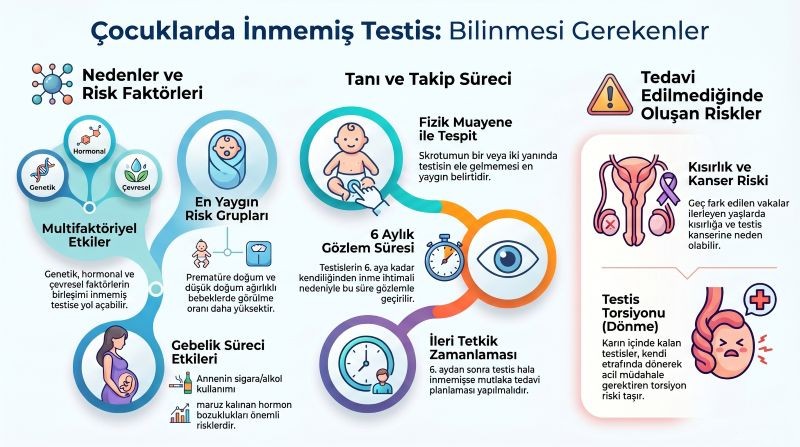
Undescended testicles are usually associated with multiple contributing factors, including genetic, hormonal, and environmental influences. Risk factors for undescended testicles include:
- Premature birth (preterm delivery)
- Low birth weight
- Family history of undescended testicles
- Exposure to hormonal disturbances during fetal development
- Maternal smoking or alcohol consumption
Symptoms and Diagnosis of Undescended Testicles
The most common sign of an undescended testicle is the absence of a testicle from one or both sides of the scrotum and the inability to feel it during examination. It is usually detected during a physical examination after birth.
In newborn babies, the condition may be noticed during the first examination. However, because the testicle may descend spontaneously until the age of six months, this period is generally spent under observation. If the testicle has still not descended after six months, further evaluation and treatment planning are necessary.
If an undescended testicle goes unnoticed, it may lead to serious consequences later in life, including infertility and testicular cancer. In addition, a testicle remaining inside the abdomen is at risk of torsion (twisting).
Treatment Methods for Undescended Testicles
The main goal of undescended testicle treatment is to move the testicle into the scrotum while preserving testicular function and preventing future complications (such as infertility and testicular cancer). Starting treatment at the appropriate time is one of the most important factors directly affecting its success rate.
Orchiopexy (Surgery to Bring Down the Testicle)
Orchiopexy is the standard surgical procedure used to position an undescended testicle in the scrotum and is generally performed between 6 and 18 months of age. It is carried out under general anesthesia. The testicle is carefully separated from its surrounding tissues. It is then brought down through the inguinal canal into the scrotum and secured in place. The procedure takes approximately 45–60 minutes. The success rate for unilateral undescended testicles is over 95%. This procedure reduces the risks of testicular torsion, atrophy, and cancer.

Hormone Therapy (hCG and GnRH)
Hormone therapy may be used in certain cases before surgery or in very young children to encourage testicular descent. It is effective in approximately 20–30% of cases. It is generally not sufficient on its own and is used as an adjunct to surgery. Side effects may include increased appetite, irritability, and temporary enlargement of the genital organs.
What Happens If an Undescended Testicle Is Not Treated?
In individuals with undescended testicles, sperm production may decrease significantly. Early treatment reduces this risk. The risk of cancer developing in a testicle that remains inside the abdomen is 4–10 times higher than in a normally descended testicle. A testicle in an abnormal position is also at risk of twisting, which requires emergency surgery.
Click here for all the information you need about circumcision.
Frequently Asked Questions About Undescended Testicles
Frequently Asked Questions About Undescended Testicles
Can an undescended testicle descend on its own?
Yes, in some cases, it may descend spontaneously by the age of 6 months. However, if it has not descended after this period, treatment is required.
When should surgical treatment for an undescended testicle be performed?
It is recommended to be performed between 6 and 18 months of age. This age range improves the success rate and testicular health.
Is undescended testicle surgery risky?
It is a simple procedure performed under general anesthesia. The risk of complications is low.
Is one testicle sufficient?
If one testicle is healthy, reproductive function is generally preserved. However, regular follow-up is necessary.
Can an undescended testicle lead to cancer?
The risk of testicular cancer is increased in testicles that remain in the abdomen. Therefore, early intervention is important.
Can an undescended testicle detected during puberty be treated?
Yes, but sperm production may have been negatively affected because treatment may have been delayed. Nevertheless, surgery is performed to reduce the risks.