Today, with the rapid advancement of medical technology, more precise, safe, and comfortable methods are becoming increasingly prominent in surgical procedures. One of these innovations, robotic surgery, offers impressive results, especially in pediatric patients.
This method, which provides high success rates with minimal trauma in cases requiring surgery at a young age, has become a major advantage for both surgeons and families. Let's take a closer look at what robotic surgery in children is, where it is used, and the benefits it provides.

What Is Robotic Surgery in Children?
Robotic surgery is an advanced surgical technique performed by a surgeon with the assistance of robotic systems. In this method, instead of operating directly over the patient, the surgeon controls robotic arms through a specialized console. These systems are equipped with high-resolution cameras providing three-dimensional images and small surgical instruments capable of movements with a level of precision beyond that of the human hand. Robotic surgery is generally an advanced form of laparoscopic, or minimally invasive, surgery. However, thanks to the range of motion and image clarity provided by robotic systems, highly effective results can be achieved, particularly in patients with smaller and more delicate anatomical structures, such as children.
Because robotic systems allow surgeons to operate without hand tremors and with millimeter-level precision, the risk of damaging healthy tissues during surgery is minimized. Additionally, the surgeon can view the surgical area in a magnified, three-dimensional format through the robot's cameras, allowing for more detailed and careful work. The use of this technology in pediatric surgery makes all the advantages of minimally invasive techniques safer and more effective for young patients.

Applications of Robotic Surgery in Children
Robotic surgery in children has become increasingly widespread in recent years and is successfully used in many different fields. One of its most common applications is urological surgery. Particularly in conditions such as ureteropelvic junction obstruction, urinary tract problems, and vesicoureteral reflux, robotic surgery offers less traumatic and more effective results. In these cases, robotic surgery, which has replaced traditional open surgery in certain procedures, allows children to experience less pain and recover more quickly.
Robotic surgery also stands out as an effective method in the treatment of certain congenital or acquired diseases involving the digestive system.
Thanks to robotic systems, structural abnormalities of the esophagus, stomach, and intestines can be treated in less time and with a lower risk of complications. For example, in the surgical treatment of gastroesophageal reflux disease, robotic techniques both shorten the duration of the operation and facilitate recovery.
Robotic surgery has also begun to be used in certain surgical procedures involving the heart and chest. In more complex procedures such as thoracic (chest cavity) surgery in children, this method allows surgeons to work with greater control. Although its use in cardiac surgery is still limited, its application in this field is expected to increase as technology develops.
Advantages of Robotic Surgery for Children
One of the greatest advantages of robotic surgery for children is that it is minimally invasive (performed through small incisions). As a result, risks such as postoperative pain, blood loss, and infection are significantly reduced. Since traditional surgical methods often require larger incisions, children may experience more trauma and longer recovery periods. In contrast, robotic surgery generally allows children to be discharged within a few days and return to their daily routines shortly afterward.
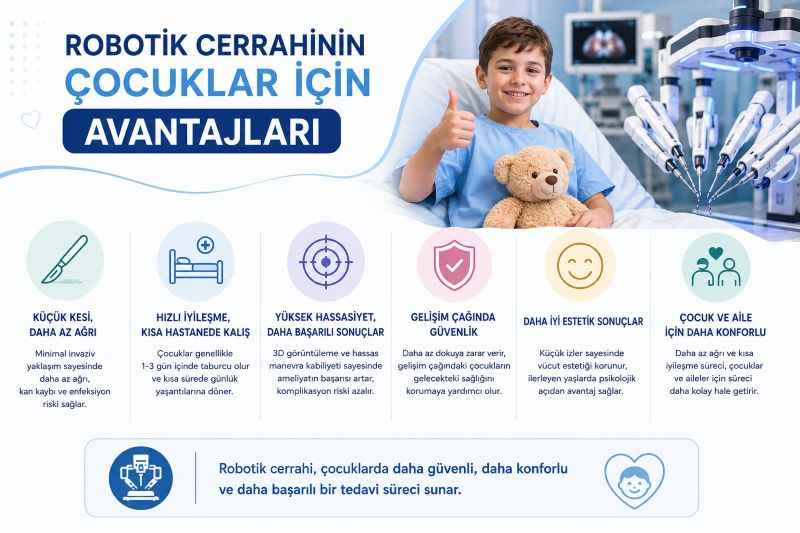
Furthermore, the high-resolution imaging and precise maneuverability provided by robotic systems increase surgical success while significantly reducing the risk of complications. This is particularly important for growing children because their future health is directly affected by such surgical procedures. Since robotic surgery causes less tissue damage, it also provides better cosmetic outcomes for the child's body. This may also help prevent potential psychological effects later in life.
Because children experience less pain and recover more quickly after surgery, they may also cope with the surgical process more easily from a psychological perspective. Shorter hospital stays make the experience more comfortable for both children and their families. This demonstrates that robotic surgery has positive effects not only medically but also emotionally and socially.
Frequently Asked Questions About Robotic Surgery in Children
Frequently Asked Questions About Robotic Surgery in Children
Why is robotic surgery preferred in children?
It provides less bleeding, less pain, and faster recovery.
For which conditions is robotic surgery used?
Urological problems, digestive system diseases, and certain thoracic and cardiac surgeries.
What are the advantages of robotic surgery for children?
Small incisions, less scarring, shorter hospital stays, and a lower risk of complications.
Is every child suitable for robotic surgery?
No. An assessment is made based on the child's age, weight, and medical condition.
Are there risks associated with robotic surgery for children?
Yes, technology-related malfunctions may occur, but it is generally safe.
How long is the recovery period after robotic surgery in children?
Patients can generally be discharged within a few days.
Does robotic surgery offer cosmetic advantages?
Yes, scars are less noticeable thanks to smaller incisions.
Which procedures can be performed using robotic surgery in children?
Urinary tract, kidney, gastrointestinal, pancreatic, and certain cardiac surgeries.
Why is robotic surgery ideal for children?
It enables precise work on small anatomical structures.