



The question what is robotic surgery can be answered as a computer-assisted surgical approach in which the operation is controlled by the surgeon through a console. The robot does not perform the surgery on its own; the surgeon’s hand movements, commands, and decisions are transmitted through the system to the instruments in the surgical field.
In this method, a camera and surgical instruments placed through small incisions are used. Features such as magnified three-dimensional imaging, instruments with enhanced range of motion, and tremor filtering may help the surgeon work more precisely, especially in narrow anatomical areas.
- Robotic Surgery in Brief
- How a Robotic Surgery System Works
- Surgeon Console
- Patient-Side Robotic Unit
- Three-Dimensional Imaging System
- Robotic Surgical Instruments
- Does the Robot Perform Robotic Surgery?
- How Is Robotic Surgery Performed?
- Differences Between Robotic, Laparoscopic, and Open Surgery
- Technical Capabilities Robotic Surgery Provides to the Surgeon
- Advantages of Robotic Surgery
- Uses of Robotic Surgery in Urology
- Is Robotic Surgery Suitable for Every Patient?
- Why Is Surgeon Experience Important in Robotic Surgery?
- Robotic Surgery in Ankara
- Frequently Asked Questions About Robotic Surgery
Robot-assisted surgery is not an independent system that replaces the surgeon, but a technological platform that supports the surgeon’s vision and movement control. The FDA also states that robot-assisted systems cannot perform surgery without direct human control.

Robotic Surgery in Brief
- The operation is performed by the surgeon, not by the robot.
- The robotic arms reproduce the surgeon’s movements simultaneously.
- The surgical field is viewed in a magnified three-dimensional image.
- The method is generally performed through small incisions.
How a Robotic Surgery System Works
A robotic surgery system works by transferring the surgeon’s hand and finger movements to specialized instruments in the surgical field. The surgeon personally controls every movement made at the console; the system does not make independent decisions or perform any action without the surgeon’s approval.
A broad movement made by the surgeon can be converted by the system into a smaller and more precise instrument movement. This may make it possible to perform more controlled maneuvers, especially in deep or narrow areas surrounded by important blood vessels and nerves.
Robotic systems generally consist of a surgeon console, a patient-side unit, robotic instruments, and imaging components.
Surgeon Console
The surgeon console is the control center from which the operation is managed. The surgeon sits at the console, views the camera image, and moves the surgical instruments using hand controls.
The console allows the surgeon to evaluate the surgical field with a high-resolution image that preserves depth perception. The surgeon controls procedures such as cutting, grasping, separating, cauterizing, and suturing from this section.
The surgeon’s position at the console does not mean that the operation is performed remotely or automatically. The surgeon remains in the operating room together with the surgical team.
Patient-Side Robotic Unit
The patient-side unit contains robotic arms that hold the camera and surgical instruments. These arms are positioned next to the patient and connected to small access points prepared according to the area where the operation will be performed.
Each arm may perform a different function. One arm may carry the camera system, while the others may control instruments used for grasping, cutting, suturing, or separating tissues.
The robotic unit moves in response to commands given by the surgeon from the console. The system does not independently change direction, cut tissue, or alter the surgical plan.
Three-Dimensional Imaging System
One of the important technical features of robotic surgery is its ability to provide three-dimensional imaging. The camera image is transmitted to the surgeon console in a magnified form while preserving depth perception.
Depth perception may contribute to a more detailed evaluation of blood vessels, nerves, tissue boundaries, and the distances between organs. This feature may offer technical advantages to the surgeon, especially during operations performed in narrow anatomical regions such as the pelvis.
High image quality alone does not guarantee a successful surgical outcome. Correct interpretation of the image and proper execution of surgical steps are related to the surgeon’s training and experience.
Robotic Surgical Instruments
Robotic instruments have an articulated structure compared with conventional straight laparoscopic instruments. These tools imitate the movements of the human wrist, can rotate in different directions, and may provide a wider range of motion in confined spaces.
In some systems, the surgeon’s natural hand tremor is filtered so that a steadier movement is transmitted to the instrument. Motion scaling may also convert the surgeon’s hand movement into a smaller and more controlled movement within the surgical field.
The official technical descriptions of the da Vinci system also emphasize magnified 3D imaging, articulated instruments, and tremor filtering.
Does the Robot Perform Robotic Surgery?
No. During a robotic operation, all surgical decisions and movements are controlled by the surgeon performing the procedure. The robot is not an independent device that makes decisions in place of the surgeon or operates on its own.
The surgeon remains at the console throughout the operation and controls the movements of the robotic system, including the camera. A surgical team is also present at the patient’s side to manage instrument changes, system safety, and the other stages of the procedure.
Robotic surgery and artificial intelligence are not the same concept. Artificial intelligence may be used in some systems for supportive purposes such as image analysis, training, or performance assessment. However, in routine robotic operations today, the surgical procedure is directed by the surgeon.
The da Vinci robotic surgery system is not an autonomous surgical robot; it is a surgeon-controlled surgical platform.
How Is Robotic Surgery Performed?
The answer to the question how robotic surgery is performed may vary according to the type of operation. The general process consists of the following stages:
Preoperative evaluation: The characteristics of the disease, imaging results, general health status, and previous operations are reviewed.
Anesthesia and preparation: The patient is placed in the appropriate position for surgery under general anesthesia.
Creation of access points: Small incisions are prepared so that the camera and instruments can be inserted.
Placement of the camera and instruments: Special ports are used to reach the surgical area.
Positioning of the robotic system: The robotic arms on the patient-side unit are connected to the access points.
Management of the operation: The surgeon moves to the console and controls the camera and instruments.
Completion of the procedure: Once the necessary surgical steps are completed, the instruments are removed and the incisions are closed.
The number of incisions, duration of surgery, and instruments used are not the same for every operation. These are determined according to the type of surgery, the patient’s anatomy, and the surgical technique to be used.
Differences Between Robotic, Laparoscopic, and Open Surgery
Robotic surgery may be considered a technologically supported form of laparoscopic surgery. However, the method of application, instrument structure, and the surgeon’s access to the surgical field differ among all three approaches.
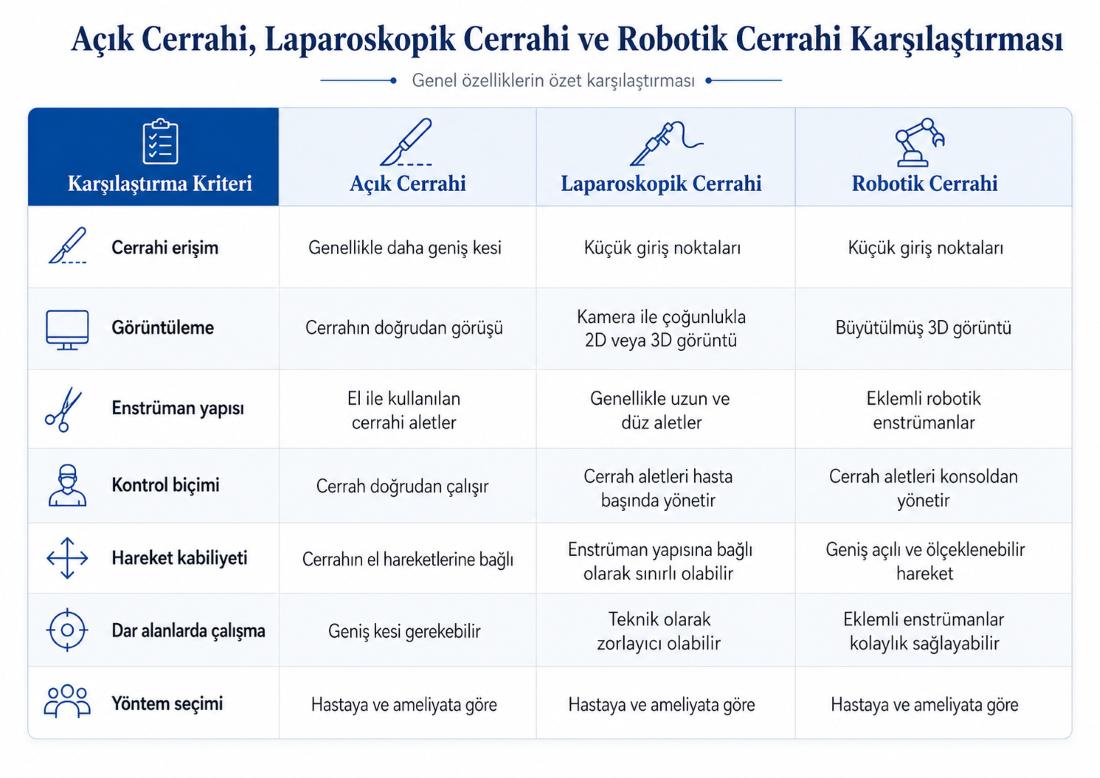
Laparoscopic surgery is a method in which a camera and long surgical instruments are advanced through small incisions. Similar access points may also be used in robotic surgery, but the instruments are controlled by the surgeon from a console.
During open surgery, the surgeon reaches the surgical area through a larger incision. In some complex, advanced, or emergency situations, the open approach may be more appropriate or safer.
For this reason, the robotic method should not automatically be considered superior for every operation. The surgical method is determined by considering the extent of the disease, the patient’s characteristics, the goals of surgery, and the surgeon’s assessment together.
Technical Capabilities Robotic Surgery Provides to the Surgeon
The main purpose of the robotic system is to support the surgeon’s control and range of motion. The key technical features from the surgeon’s perspective include:
Magnified three-dimensional surgical imaging
Preservation of depth perception
Filtering of the surgeon’s natural hand tremor
Wide range of motion with articulated instruments
Controlled work in narrow anatomical areas
Precise suturing and tissue dissection
The ability for the surgeon to work while seated in an ergonomic position
Direct camera control by the surgeon
These features may facilitate the performance of delicate surgical steps. However, technological capabilities alone do not determine the outcome of surgery. Patient selection, surgical planning, team experience, and the characteristics of the operation also influence the result.
Advantages of Robotic Surgery
The advantages of robotic surgery may vary according to the type of operation and the patient’s health status. Because the method is performed through small access points, it may result in a more limited surgical incision than open surgery in some patients.
Potential patient benefits may include:
Smaller surgical incisions
Less blood loss in some operations
Possibly less postoperative pain
A potentially shorter hospital stay
Earlier return to daily life
Smaller surgical scars
The ability to work in a controlled manner in narrow anatomical areas
More detailed visualization of some delicate structures
Minimally invasive surgery aims to reach the target area through smaller access points rather than a large incision. Procedures commonly known as closed surgery may also be considered within this approach.
These benefits do not occur to the same degree in every patient. Recovery depends on the extent of surgery, the patient’s age, accompanying diseases, duration of the operation, and the characteristics of the surgical procedure.
Uses of Robotic Surgery in Urology
Robotic surgery in urology may be considered especially for operations requiring precise dissection and suturing in narrow anatomical areas. The decision to use the robotic method is based not only on the name of the disease but also on all characteristics of the patient and the planned operation.
The main urological areas in which the robotic method may be used include:
Kidney tumor surgery
Procedures in which the entire kidney or only the tumor-bearing part is removed
Bladder surgery
Surgery for narrowing at the kidney outlet
Ureteral repairs
Certain bladder repair operations
Selected reconstructive urology procedures
Appropriate pediatric urology operations
These headings describe general areas in which the robotic method may be used. The fact that a particular disease can be operated on robotically does not mean that every patient is suitable for this method.

Is Robotic Surgery Suitable for Every Patient?
No. The question who is suitable for robotic surgery cannot be answered by considering only age or the name of the disease. The patient’s complete medical profile and the planned operation must be evaluated together.
The following factors may be considered when assessing suitability:
- The type, location, and extent of the disease
- The technical requirements of the planned operation
- The patient’s age and general health status
- Heart and lung function
- Previous abdominal or pelvic operations
- The possibility of adhesions in the surgical area
- The patient’s body structure
- Other surgical methods that may be used
- The experience of the surgical team
- The technical infrastructure of the healthcare center
Advanced age alone is not a barrier to robotic surgery. However, anesthesia risk, heart and lung diseases, and the special positions required by the operation should also be evaluated.
Why Is Surgeon Experience Important in Robotic Surgery?
Robotic surgery is a system that supports the surgeon technically rather than replacing the surgeon. Therefore, it is not appropriate to assess the surgical outcome only according to the model of the device used.
The surgeon’s experience is particularly important in the following stages:
- Selecting the right patient
- Planning the operation in detail
- Correctly interpreting anatomical structures
- Using robotic instruments in a controlled manner
- Managing unexpected situations during surgery
- Changing the surgical method when necessary
- Recognizing complications early
- Planning postoperative follow-up
Having a surgical team trained in robotic systems is at least as important as the surgeon’s individual experience. The patient-side team manages instrument changes, system setup, and processes related to surgical safety.
Robotic Surgery in Ankara
For patients researching robotic surgery in Ankara, the evaluation process includes factors such as the type of disease, the extent of surgery, general health status, and suitability for the robotic method. Robotic surgery is a minimally invasive approach in which the surgeon views the surgical field with a magnified three-dimensional image and controls the robotic instruments from a console. However, this method may not be suitable for every patient or every operation. When robotic surgery is considered in Ankara, the method to be used should be determined individually by evaluating examination findings, test results, alternative surgical approaches, and the surgeon’s medical assessment together.
Frequently Asked Questions About Robotic Surgery
Can Robotic Surgery Be Converted to Open Surgery During the Procedure?
Yes. If bleeding, extensive adhesions, anatomical difficulties, or another safety-related requirement occurs, the operation may be continued using an open surgical approach.
Can Robotic Surgery Be Performed on Patients Who Have Previously Had Abdominal Surgery?
It may be suitable for some patients. The possibility of adhesions caused by previous operations is evaluated together with imaging findings and the surgical assessment.
Is There a Specific Age Limit for Robotic Surgery?
There is no definite age limit. The patient’s general health, anesthesia risk, and the characteristics of the planned operation are considered when making the decision.
Can Every Surgeon Perform Robotic Surgery?
Robotic surgery should be performed by surgeons who have received training and gained practical experience with the relevant system. The operating room team should also be trained in system setup and safety.
Is Robotic Surgery Risky?
Like other surgical procedures, robotic surgery may involve risks such as bleeding, infection, anesthesia-related complications, and injury to surrounding tissues. The level of risk varies according to the type of operation, the patient’s general health, and the experience of the surgical team.
How Many Hours Does Robotic Surgery Take?
The duration of robotic surgery varies according to the procedure and the complexity of the operation, although many urological procedures may take approximately 2–4 hours. Preparation, anesthesia, and postoperative recovery time may not be included in this duration.


